

A partial return to normality
Two farming conferences and growing a love of pulses in schools

Hello and welcome to my newsletter about food, people and planet. It’s free to read, but you could choose to be a paid subscriber to support my writing.
My new book In Good Taste: What Shapes What We Eat and Drink - And Why it Matters is out now and available on Waterstones, Amazon, bookshop.org and more.
This is the newsletter I started writing to share on 16th January, before I decided to stop and tell you what was really top of my mind. The bank fraud I fell victim to remains unresolved with 60% of my money being withheld by them. I am escalating the matter.
Meanwhile, they very much messed with the wrong women (and men), as I have had huge amounts of support from the wonderful world of food writing and beyond. Not only did many of you pay for a yearly subscription, but I’ve also had some thoughtful collaboration requests with the warmest of wishes. I can’t wait to share these with you as they unfold.
I’m picking up where I left off, and hope to share some book launch excitement next.
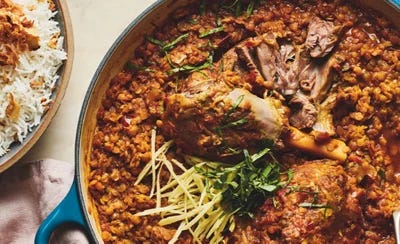
Pic: My Dal Gosht recipe for Waitrose, following below
Oxford is where the action is in January
In an unexpected turn of events, I attended not one but two farmings conferences in January. The imposter syndrome level were high. I was pretty sure I was going to stick out like a sore thumb on several levels. Farming and agriculture is the least diverse sector in the UK. I am your classic urban type, who also kills any living green thing they touch. Oh and I’m a food writer, more likely to be interested in what I can turn crops into for gastronomic pleasure and joy, than the mechanics of growing and harvesting.
What happens in farms, both in the UK and overseas, of course has a direct link to our plates. It is also fraught with challenges. You’d have to be asleep under a rock not to notice the farmers protesting their plight across the UK and in Europe.
I was already invited to chair a workshop on Growing a Love for Pulses in Schools by Bee Wilson, the founder of TasteEd, which came with the opportunity to attend Oxford Real Farming Conference (ORFC). Then I was notified that Oxford Farming Conference (OFC) has a bursary to enable access for those who wouldn’t otherwise be able to afford attendance. I applied and won the bursary.
So, there are two farming conferences in Oxford. And here’s more, they’re on at EXACTLY the same time. I was keen to listen and learn at both. I’m no stranger to multitasking, but that was fascinating, thought provoking, fun and hectic!
First up, why?
There is no obvious reason for two conferences at the same time, on the same days, in the same location. But they are different in style and the division does speak to the focus and audience of those involved in around farming and agriculture.
Oxford Farming Conference
This is a business and industry event. Much like the ones I’m used to from my long years in the corporate world. It’s primary focus is on profitabilty. This year’s theme was “resilience”. It would be unfair to say the attendees don’t care about broader themes like climate, nature, mental health, public awareness etc because their futures literally depend on these things.
It is grand, and it is expensive to attend. My bursary was to the tune of £700 and attendees pay extra to be at the dinner in the hall at Christ Church that inspired the Harry Potter set. My dinner was included. This is the student canteen by the way. I felt a pang of remorse for not having studied harder to get to Oxbridge.
The sessions were fascinating. Not least because many of these farmers supply supermarkets, where many of us buy our food and drink. Here is my top line:
The story of farming isn’t all doom, but progress isn’t fast enough
In a keynote Jack A. Bobo challenged the constant crisis narrative. Things are improving, just not at the pace the planet (or farmers) need. We don’t need dramatically more food; we need to use what we already grow far more effectively, without compromising the future.This isn’t just about policy, it’s about people feeling unheard
Loud tractor protests continued outside while politicians made U turns and new investment pledges inside. As campaigner Dominic Watters put it: this is about people who feel unheard making their voices heard.Climate change brings risk, but also opportunity
Changes in soil and land capability aren’t just threats. They’re opening up new crops, approaches and income streams. Olive oil from Essex may sound niche now, but they’re a signal of how things are shifting.Consumers do care, but they need to be invited in
The idea that “consumers don’t care about sustainability” doesn’t stack up. We pay to save our own lives, so why wouldn’t we pay to protect the planet that sustains us? I think loving food and drink without caring for the planet is still a bit like enjoying a family meal while your house is on fire.Bridging divides is where hope lies
The conference closed with Fiona Reynolds calling for a shared vision between farmers and environmentalists. The 2027 chair Sheena Horner is a chilli farmer in Scotland no less. She talked passionately about breaking down silos between organic and conventional, urban and rural. I’d add one more: between food lovers and food producers.
Next year’s theme, fittingly, is “harmony”.
Oxford Real Farming Conference
ORFC is more about grassroots, community and social movements that are working to address the challenges with industrial, commercial farming and food today. I’ve been privileged to contribute to some of these networks over the years, and many of the ideas and people I encountered have fed directly into my advisory work and writing.
From a food-lover’s perspective, a few things really stayed with me:
Organic farming still struggles for mainstream backing
It ticks many of the right boxes for food, health and planet, yet remains low on the policy priority list and hasn’t secured consistent retailer buy-in. Carrefour was cited as an example of a retailer accepting lower margins on organic to support sales.Glyphosate regulation needs urgent attention
Several speakers argued that permissible levels should be dramatically lower (by a tabled factor of 100) particularly given the gaps in long-term toxicology and animal studies.Plastics are a food issue, not just a packaging one
Only 6% of the more than 16,000 chemicals associated with plastic production are currently subject to global regulation. That has profound implications for soil, water, food systems and us.
One of the most moving sessions I attended was African women leading the land, chaired by Sandra Salazar D’eca, where Deirdre (Dee) Woods spoke powerfully about the new Granville Farm project, a land sharing community farm initiative supported by the Cherry family of Groundswell Festival.
Much of what was said in that room will stay with me for a long time:
Each one of us is a seed, and we all have a contribution to make
Everything you need to know is already inside you
What happens in the ground, happens to us
We go together, we grow together
The last one seemed particularly apt.
My verdict
Sadly, the way farming and agriculture works right now means there is a need for two separate conferences. However, there is a sweet spot where the conversations and dialogues meet.
Despite the obvious differences between the conferences, it was pleasing to see a number of people attend both. I heard this number is growing too.
Perhaps hosting them on different days in the same week might help expand this sweet spot and help people and topics meet in the middle a bit more?
Growing a love of pulses in schools
On the subject of growing, our food preferences are formed early. In India, rice and lentils are often among a baby’s first tastes. Beans, peas and lentils aren’t “introduced”, they’re simply there as a part of everyday meals and life.
That’s why it was a pleasure to play a small part in a big initiative introducing young people in the UK to the flavour, flexibility and possibility of pulses.
I chaired a packed workshop with Bee Wilson and Dr Jason O’Rourke on Growing a love for pulses in schools, sharing the thinking and learnings behind TasteEd’s work, supported by Nick Saltmarsh of Hodmedod.
It was a masterclass in what passion looks like in action. What stayed with me was how powerful curiosity and joy can be. In a classroom of hesitant children, it often takes just one or two brave pupils to try something new and the rest follow. Many diverse young people are already on side. Bring them into the conversation, and they help make the magic happen.
TasteEd now works with over 1,800 schools and nurseries, showing that when children are given permission to explore taste, pulses and vegetables can feel familiar, fun and full of possibility. Bee has written beautifully and in depth about the session and the wider work here, which is well worth your time.
Some other interesting things for your attention:
Our health and the health of the planet are closely linked and I was on the Doctor’s Kitchen podcast by my friend Rupy Aujla talking about this and my book. You may also find his latest episode on glyphosates interesting
Sue Quinn wrote a great piece about what Britain can now grow given rising temperatures, which was in line with what Jack Bobo was saying. We will, of course, lose crops too
It’s not all doom and gloom! A new paper on the ‘Plymouth fish finger” project was hopeful reading despite its long-winded title. I did a little video on it outside my local chippie if you’re interested in a snappy download
If you need a hearty winter recipe that bangs in some beans AND uses quality meat cost-effectively, my Dal Gosht was cooked by Angela Hartnett on the Waitrose Dish podcast for Nick G, Stephem Graham and Erin Doherty, fresh from the Golden Globe wins. The recipe is here. This should be made with chana dal, which Waitrose doesn’t stock, and no lamb stock please!
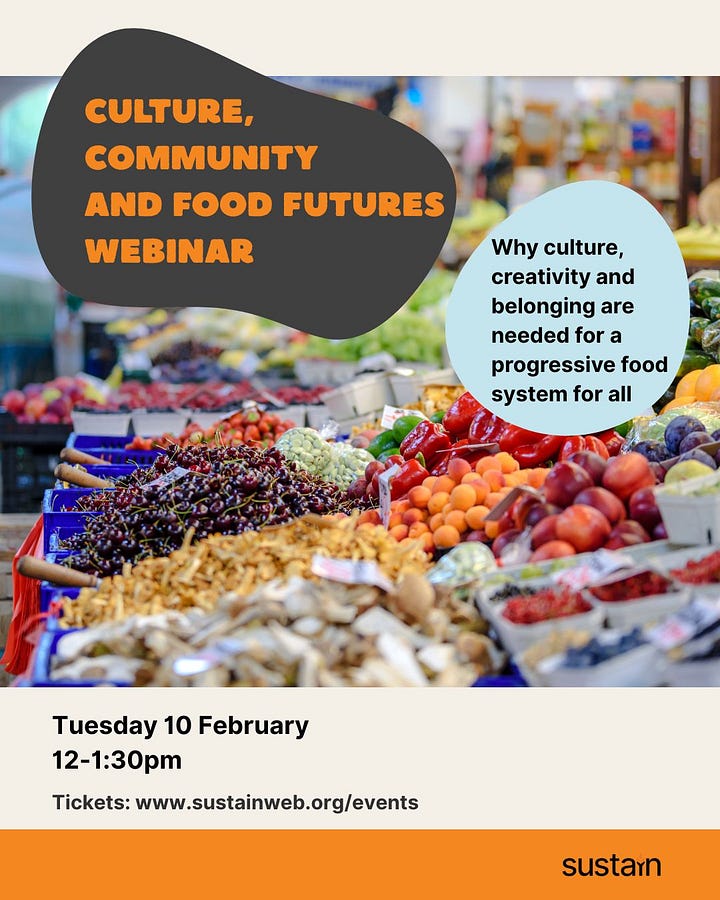
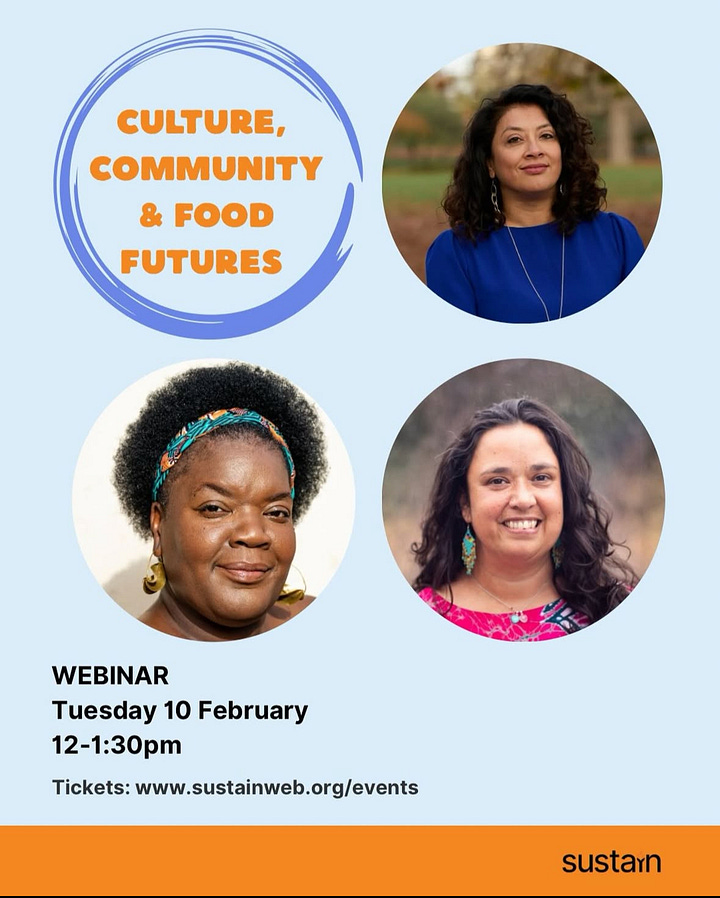
What knowledge, creativity and leadership do people from the global majority bring to food systems? I’m speaking at Sustain and Culture Roots Collectives free webinar with Betty Vandy of Liverpool’s Gather at the Table and Gnisha Bevan of Black Seeds Network on Tuesday 10th Feb, if you’re keen. Come along!


That’s all from me. Please do keep those fingers and toes crossed my bank fraud monies are returned soon and normal service can resume on my end. Thank you for being here.
Love the school pulses initiative and the Oxford Conferences sound like a very fertile experience. Fortuna fortiter favet!